Hyundai models and CNG options
Model names identify families for enquiry. Engine, variant, model year and destination requirements must be confirmed separately; a listed family does not establish approval for every version.
- AccentAccent Viva
- Alcazar
- Aura
- Creta
- Elantra
- Eon
- Exter
- Getz
- Grand i10
- Grand i10 Nios
- i10
- i20 / Elite i20Including N Line
- i20 Active
- Santro / Santro Xing
- Tucson
- VenueIncluding N Line
- VernaFluidic Verna
- Xcent / Xcent Prime
Application-specific export quotation
Request a quotation for your country, exact vehicle and engine, selected system and order quantity. Confirm whether the quotation includes the ECU, reducer, injectors, cylinder or tank, valves, wiring, installation, freight, taxes and destination documentation. No domestic fitted price is an export quotation.
CNG mileage and savings
For standard Conventional and Sequential systems, a general thumb rule is CNG mileage in km/kg ≈ 1.5 × your petrol mileage in km/l. For example, 10 km/l gives an estimated 15 km/kg.
This rule does not apply to DI engines. Use the savings calculator for listed DI vehicles; contact MIJO for an estimate if your vehicle is not listed.
Cylinder choice and boot space
Car-cylinder options include 60 L and 65 L single cylinders and smaller twin-cylinder (dual-cylinder) combinations. Compare remaining luggage space, seating and spare-wheel access with the installer.
See cylinder options · Understand filling capacity and tank layout
Installation, service and warranty
Agree installation and commissioning responsibilities, training, maintenance intervals, spare-parts supply and written warranty terms with MIJO and the confirmed local partner before ordering. Service arrangements and warranty coverage depend on the application and supply agreement.
Plan your export enquiry
Send your country, company, vehicle make and model, engine code, model year, transmission and expected quantity. Include any AMT, AGS, CVT, IVT, DCT or 4×4 configuration. MIJO can review the application, documentation and supply options before confirming a quotation.
Questions before fitment
What should an export quotation include?
Request a quotation for your country, exact vehicle and engine, selected system and order quantity. Confirm whether the quotation includes the ECU, reducer, injectors, cylinder or tank, valves, wiring, installation, freight, taxes and destination documentation. No domestic fitted price is an export quotation.
How do Conventional, Sequential, DPI and DI systems differ?
- Conventional: gas is mixed with the intake air through a mixer.
- Sequential: an ECU controls gas delivery through individual injectors.
- DPI (Dual Point Injection): two port injectors per cylinder require the corresponding Sequential configuration. MIJO’s four-cylinder, eight-injector DPI configuration uses a dedicated 4×8 ECU.
- DI (Direct Injection): requires a dedicated system developed for the direct-injection engine.
These are MIJO’s system categories; availability follows the engine applications described on this page. DPI differs from Direct Injection; turbocharging alone does not distinguish MPI, turbo-MPI and DI.
MIJO Direct Drive 2.0 uses KME ECU technology from Poland for supported DI applications.
How does a standard Sequential CNG system work?
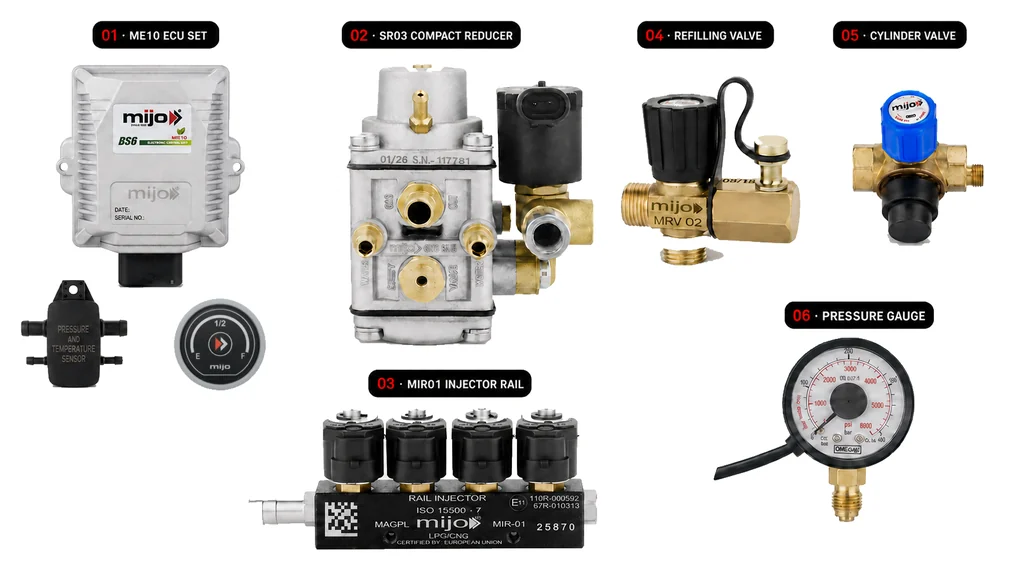
CNG means Compressed Natural Gas. In a Sequential system, the reducer lowers gas pressure, injectors meter gas and the ECU coordinates delivery. Three-cylinder, four-cylinder and other supported configurations use the corresponding ECU and injectors.
Standard port-injected Sequential systems start on petrol and change automatically to CNG at calibrated operating conditions; the driver can select petrol when needed.
Which Hyundai engines use Sequential CNG or Direct Injection?
Hyundai Venue CNG options differ between the Kappa 1.2 MPi petrol engine, which uses Sequential for eligible applications, and the 1.0 Turbo GDi, for which MIJO has a technically developed DI solution. Creta 1.5 MPi and 1.5 Turbo GDi likewise use different system categories. Earlier cars, including Creta 2020, retain their own specifications.
The standard i20 1.2 L Kappa with manual or IVT differs from Turbo GDi and N Line applications. Older i20 Active, Elite i20 and 2012–2018 models also retain their original engines. Older i10/Grand i10 1.2L Kappa or Kappa2 cars differ from Grand i10 Nios. Hyundai BS6 applications include DPI; a facelift or base-model name alone does not identify the system.
How do Indian factory-vehicle references differ from a MIJO export quotation?
An on-road price includes buying the vehicle; a MIJO quotation covers conversion of your existing petrol car.
Hyundai’s Indian listings checked on 5 September 2026 showed petrol for the standard i20 and petrol/diesel for Venue and Creta, with no factory CNG variant shown for those ranges. Grand i10 Nios Hy-CNG Duo was separately listed with two cylinders. These are Indian-market references; confirm the current vehicle specification and availability in the destination country. Factory layout and warranty do not describe an independent MIJO retrofit.
Ask Hyundai in the destination country about current i20, Venue or Prime SD availability, vehicle specification and purchase pricing. A factory-vehicle purchase and an independent MIJO conversion have different providers and quotation scopes.
MIJO supplies independent aftermarket systems and support. This does not represent Hyundai genuine-accessory, factory-supplier, showroom-installer or Hyundai-authorised service status.
How do I measure actual CNG mileage and running cost?
Divide distance travelled on CNG by kilograms refilled over comparable fills. CNG mileage is measured in km/kg; petrol mileage uses km/l. Traffic, load, driving style, vehicle condition and calibration affect the result.
For running cost per kilometre, divide the local fuel price by actual mileage in its matching units. The calculator uses local fuel prices and monthly kilometres to estimate savings and conversion payback. Estimates are not guaranteed or factory-certified mileage.
How much CNG fits in a cylinder, and what space will remain?
Litres describe water capacity, not gas weight. For a standard system, a 60 L cylinder holding about 8 kg at 15 km/kg gives an estimated 120 km range. Actual fill varies with residual pressure, gas temperature, station pressure and cut-off.
Compare cylinder size, weight, mounting, valve access, ground clearance, usable seating, luggage and spare-wheel access with your normal passenger load and any commercial equipment. Factory boot volume or another car’s installation does not specify the space remaining in yours.
Confirm the cylinder manufacturer, specification and applicable cylinder documents. MIJO supplies the conversion kit; cylinders are sourced from cylinder manufacturers.
How do I arrange servicing, software or replacement parts?
Contact MIJO or the confirmed supply partner with the invoice, system identification and service record. Kit warranty, installer workmanship and vehicle-manufacturer warranty have separate terms. Agree local servicing and parts support in writing; ask for an itemised quote covering work, parts, labour and taxes. Continue the engine-oil and spark-plug maintenance specified by the car manufacturer.
For poor running, warning lights, fuel-level readings or calibration, provide ECU/component identification, installation history and symptoms. Software and wiring downloads and replacement filters, reducers, switches, sensors, emulators and other components and accessories must match the installed system. Installation includes calibration, leak and operating checks and a road check.
Which approvals and documents do I need for a new CNG kit?
Confirm destination-country requirements for the exact vehicle and kit, including any required approval, installation inspection, registration and insurance documentation. Indian ARAI or ICAT application records do not establish approval in another country. Request the documents applicable to the proposed export configuration from MIJO.
MIJO does not support the use or installation of a second-hand CNG kit. Choose a new, complete MIJO kit installation with applicable approval documents and written warranty terms.
Who makes MIJO kits, and what support is available?
MIJO develops and manufactures CNG and LPG systems in Kundli, Delhi NCR. Established in 2001, its in-house product development, tooling, machining, assembly and testing support a company-wide record of 1 Million+ Customers, a 1,000+ Dealer Network and exports across 17+ countries. See our manufacturing capabilities.
Export partners can arrange destination-market documentation, training, spare parts and after-sales service support through MIJO.
What about LPG, diesel or electric vehicles?
Diesel, battery-electric, two-wheeler and heavy-vehicle applications are outside this passenger-car petrol-to-CNG guide. LPG requires a separate system, tank, storage components, assessment and quotation; CNG prices, km/kg figures and fill estimates do not describe LPG. Explore Sequential LPG.
For a Hyundai already fitted with factory LPG or CNG, identify its existing fuel system before new work. Include the actual manual, automatic, AMT, IVT or DCT transmission in the enquiry.