Find your car
Each model name includes its variants and sub-variants. The list brings together MIJO’s recorded fitments and application records, including older cars.
| Brand | Models |
|---|---|
| Nissan | Gravite · Kicks · Magnite · Micra / Micra Active · Sunny · Terrano |
| Datsun | GO · GO+ · redi-GO |
| Citroën | Basalt · C3 · C3 Aircross |
| Ford | Aspire / Figo Aspire · EcoSport · Fiesta · Figo · Freestyle · Fusion · Ikon |
| Chevrolet | Aveo / Aveo U-VA · Beat · Enjoy · Optra / Optra Magnum · Sail / Sail U-VA · Spark |
| MG | Hector · Hector Plus |
| Volkswagen | Ameo · Beetle · Jetta · Passat · Polo / Cross Polo · Vento |
| Škoda | Fabia · Laura · Octavia · Rapid · Superb |
| Jeep | Compass |
| Audi | A3 · A4 · A6 · Q2 · Q3 · Q5 |
| BMW | 3 Series · 5 Series |
| Mercedes-Benz | A-Class · B-Class · C-Class · E-Class · GLA · GLC |
| Fiat | Avventura · Linea / Linea Classic · Palio / Palio Stile / Palio WR · Punto / Grande Punto / Punto Evo / Punto Pure |
| Hindustan Motors | Ambassador |
| Jaguar | XF |
| Volvo | S60 · V40 |
| Mitsubishi | Lancer |
| Opel | Corsa |
| Premier | Rio |
Petrol applications are covered here; diesel and battery-electric versions are outside this conversion route.
Strong hybrids: MIJO has a technically developed CNG solution for export enquiries, subject to destination requirements. It is not currently available for approved retrofitment in India. Smart Hybrid and mild-hybrid support remains separate.
CNG fitment prices
- ConventionalSuitable BS3 petrol cars
- ₹30,000–₹35,000Complete fitment
- Sequential CNGBS3 and later port-injected petrol cars; the system used from BS4 onward
- ₹40,000–₹70,000Complete fitment
DPI Sequential: ₹55,000–₹70,000. This is a subgroup within the Sequential range for supported Dual Point Injection applications.
The dealer confirms your exact price from the cylinder capacity, engine technology, selected components and any additional parts needed for your car.
CNG mileage and savings
For standard Conventional and Sequential systems, a general thumb rule is CNG mileage in km/kg ≈ 1.5 × your petrol mileage in km/l. For example, 10 km/l gives an estimated 15 km/kg.
The standard CNG mileage thumb rule does not apply to DI engines. Use the savings calculator for listed DI vehicles; contact MIJO for an estimate if your vehicle is not listed.
Cylinder choice and boot space
Car-cylinder options include 60 L and 65 L single cylinders and smaller twin-cylinder (dual-cylinder) combinations. Compare remaining luggage space, seating and spare-wheel access with the installer.
See cylinder options · Understand filling capacity and tank layout
Installation, service and warranty
- Installation
- Usually 5–6 hours, including calibration, leak and operating checks, and changeover instructions.
- First service
- 1,500 km or 2 months, whichever comes first.
- Regular servicing
- At the scheduled 10,000-km / 6-month milestones, whichever comes first. Continue your car manufacturer’s normal maintenance too.
- Kit warranty
- 1 year from fitment or 40,000 km, whichever comes first.
Warranty covers the main kit components, subject to the terms in the owner’s manual. Consumables, pipes and accessories are excluded from warranty coverage.
Plan CNG fitment for your car
Share your make, model, variant, manufacturing year, transmission and city or PIN code, plus the engine code if available and any modifications. MIJO or the state distributor can identify a dealer and arrange the complete-fitment quotation and local service support.
Questions before fitment
What should my complete-fitment quotation include?
Your dealer provides a dated quotation with one complete fitment price for the kit and installation, including cylinder mounting, installation labour, calibration and operating checks. Documentation charges and accessories outside the standard kit may be quoted separately. Confirm the cylinder specification, applicable taxes, final payable total and written warranty before installation.
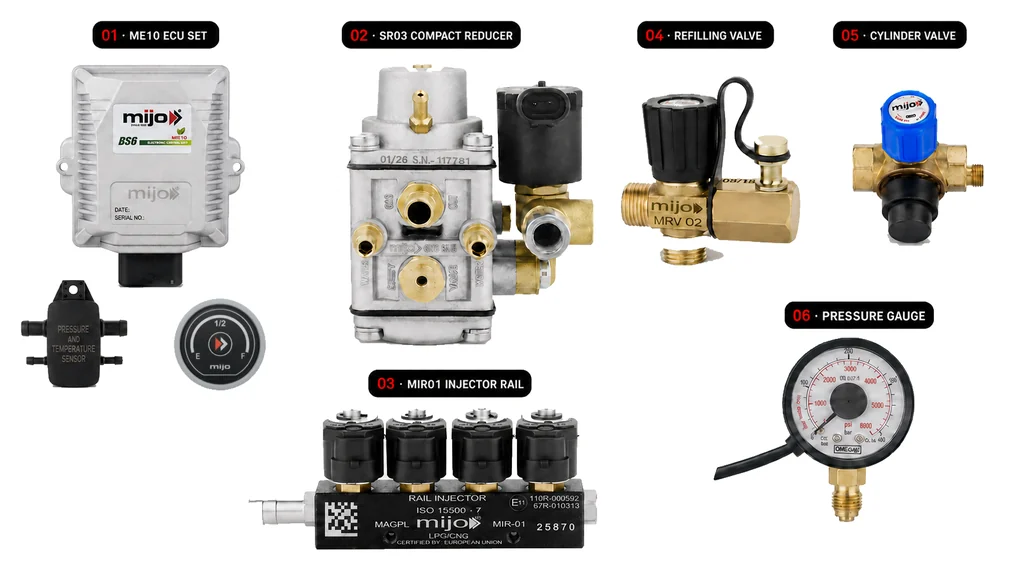
The complete system includes the selected ECU, reducer, injector rail or mixer, sensors, switch, valves, wiring harnesses, pipes and standard installation accessories.
How should I compare CNG kits for my car?
Compare the specified components, complete installed quotation, installation, calibration, applicable documentation, local support and written warranty. Gold, Premium or imported-brand labels and another model’s review do not describe your car’s configuration. See the comparison criteria.
How do Conventional, Sequential, DPI and DI systems differ?
- Conventional: gas is mixed with the intake air through a mixer.
- Sequential: an ECU controls gas delivery through individual injectors.
- DPI (Dual Point Injection): two port injectors per cylinder require the corresponding Sequential configuration. MIJO’s four-cylinder, eight-injector DPI configuration uses a dedicated 4×8 ECU.
- DI (Direct Injection): requires a dedicated system developed for the direct-injection engine.
Older Audi, BMW, Mercedes-Benz, Volkswagen and Škoda applications include port-injected engines; six-cylinder applications occur among the luxury brands. More recent applications commonly use Direct Injection. The actual engine determines the ECU and injector configuration. A turbo badge alone does not establish DI.
How does a standard Sequential CNG system work?
CNG means Compressed Natural Gas. In a Sequential system, the reducer lowers gas pressure, injectors meter gas and the ECU coordinates delivery. Three-cylinder, four-cylinder and other supported configurations use the corresponding ECU and injectors.
Standard port-injected Sequential systems start on petrol and change automatically to CNG at calibrated operating conditions; the driver can select petrol when needed.
How do I measure actual CNG mileage and running cost?
Measure actual mileage by dividing distance travelled on CNG by kilograms refilled over comparable fills. Traffic, load, driving style, vehicle condition and calibration affect the result. CNG mileage is measured in km/kg, not per litre.
For running cost per kilometre, divide the local CNG price per kg by CNG mileage in km/kg. The calculator uses local fuel prices and monthly kilometres to estimate savings and payback. Estimates are not guaranteed or factory-certified mileage.
How much CNG fits in a cylinder, and what space remains?
Litres describe water capacity, not gas weight. For a standard system, a 60 L cylinder holding about 8 kg at 15 km/kg gives an estimated 120 km of CNG range. Actual filling varies with residual pressure, gas temperature, station pressure and cut-off.
Review cylinder size, weight, mounting, valve access, ground clearance, passenger load, usable seating, luggage and spare-wheel access with the installer. Factory boot volume and another car’s installation do not specify the space left in your vehicle; include any commercial equipment in the layout discussion.
Confirm the cylinder manufacturer, specification and applicable cylinder documents. MIJO supplies the conversion kit; cylinders are sourced from cylinder manufacturers.
How do I arrange servicing, software or replacement parts?
Contact your MIJO fitment centre with the invoice, system identification and service record. MIJO kit warranty, installer workmanship terms and the vehicle manufacturer’s warranty are separate; original vehicle cover must not be assumed unchanged. Service cost depends on the work required; request an itemised quote for parts, labour and taxes, and follow the car manufacturer’s engine-oil specification.
For software, calibration or replacement parts, provide the installed ECU and component identification, installation history and symptoms, including poor running, warning lights or fuel-level readings. Filters, reducers, switches, sensors, emulators and wiring must match the system. Use the matching ECU software and wiring downloads and components and accessories catalogue. The fitment centre checks vehicle condition, installs and calibrates the system, completes leak and operating checks and a road check, and explains fuel changeover.
Which approvals and documents do I need for a new CNG kit?
Within MIJO’s Conventional and Sequential range, suitable BS3 petrol applications can use Conventional or Sequential; from BS4 onward, port-injected MPI or MPFI applications use Sequential. BS4 and BS4 OBD2 are separate approval stages, alongside BS6 Phase 1 and BS6 Phase 2. The emission stage alone does not identify injection technology.
For Conventional and Sequential fitment, obtain the applicable vehicle-kit approval documents, including certificate validity, manufacturing year and emission scope, and confirm the local RC endorsement and insurance process. ARAI or ICAT references identify the testing agency; RTO registration is a separate step.
Before fitment, your dealer checks the vehicle condition and confirms the applicable vehicle-kit approval.
MIJO does not support the use or installation of a second-hand CNG kit. Choose a new, complete MIJO kit installation with applicable approval documents and written warranty terms.
Is a MIJO retrofit the same as a factory CNG vehicle?
MIJO supplies independent aftermarket systems. A listed model does not imply OEM factory-supplier or authorised-showroom-installer status. Factory CNG specifications, cylinder layouts, certified mileage and vehicle warranty terms describe their own vehicle configurations.
For current factory availability, variants and vehicle prices, use the manufacturer’s specifications and dated quotation. A factory vehicle’s purchase price and conversion of your existing car are separate costs.
Can I enquire about LPG, diesel or commercial vehicles?
Diesel and battery-electric vehicles are outside this passenger-car petrol-to-CNG guide. Trucks, buses and other commercial applications have separate vehicle and operating requirements; a passenger model listing does not describe their cylinder or load layout.
LPG needs a separate system, tank, components, application assessment and quotation. CNG prices, mileage and fill estimates cannot be applied to LPG. Explore Sequential LPG.
Can I enquire about a strong-hybrid vehicle for export?
MIJO has a technically developed CNG solution for strong-hybrid vehicles. Export enquiries can be discussed against the exact vehicle and destination requirements. This solution is not currently available for approved retrofitment in India. Discuss an export programme.
Who makes MIJO kits, and what support is available?
MIJO develops and manufactures CNG and LPG systems in Kundli, Delhi NCR. Established in 2001, its in-house product development, tooling, machining, assembly and testing support a company-wide record of 1 Million+ Customers, a 1,000+ Dealer Network and exports across 17+ countries. See our manufacturing capabilities.
Export partners can arrange destination-market documentation, training, spare parts and after-sales service support through MIJO.