Fill and store
CNG enters through the refilling valve and is stored in the cylinder. The cylinder valve provides the cylinder-mounted outlet and manual isolation point.

MIJO CONVENTIONAL CNG · FOUR-WHEELERS
MIJO Conventional CNG combines three-stage pressure reduction, petrol-circuit management and clear driver control. The reducer, emulator, switch and high-pressure hardware are selected for the actual vehicle and market—not by age alone.
HOW CONVENTIONAL CNG WORKS
Each group has a defined job, from the cylinder-side high-pressure circuit to fuel changeover and the engine-side gas-air mixture.
CNG enters through the refilling valve and is stored in the cylinder. The cylinder valve provides the cylinder-mounted outlet and manual isolation point.
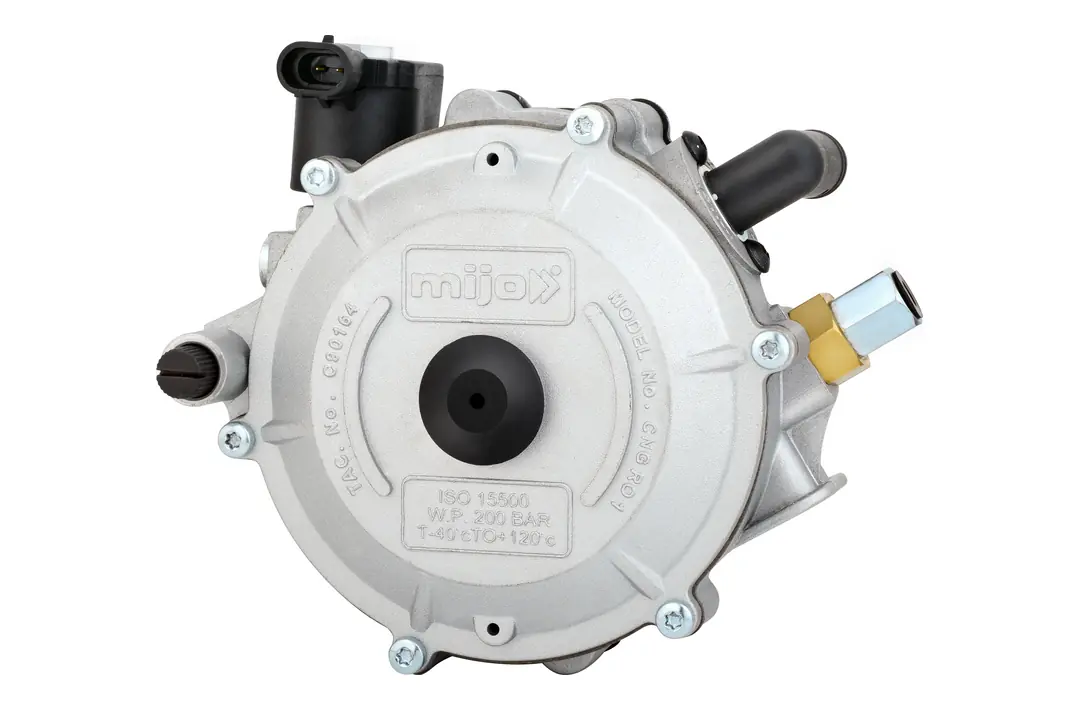
The CNGR01 reducer lowers cylinder pressure in three stages and supplies regulated gas to the engine-side metering arrangement.
For the matched MPFI application, the ME11 emulator manages the petrol-injector circuit during CNG operation. The selected cabin switch commands petrol or CNG.
The pressure gauge indicates cylinder-side pressure. A vehicle-matched mixer and calibration control the gas-air delivery required by the engine.
CONVENTIONAL CNG COMPONENT POSTCARD
The six principal components cover pressure regulation, petrol-circuit management, driver control, filling, cylinder isolation and pressure indication.
Conversion-kit supply: Harnesses, pipes and installation accessories are supplied with the kit. Separate: CNG cylinder supplied separately.

MIJO's electronic three-stage Conventional CNG reducer. Its die-cast aluminium body is designed for high-pressure CNG service, with an integrated 12 V gas shut-off and output variants selected to match engine demand.
The application-specific emulator manages the petrol-injector circuit during CNG operation and maintains the required petrol-ECU signal behaviour. MIJO selects the correct ME11 variant for the vehicle.
MIJO's feather-touch cabin control for petrol/CNG selection and gas indication in the matched Conventional CNG configuration.
Mounted directly on the storage cylinder, this valve connects the cylinder to the vehicle's high-pressure line and provides manual isolation of the stored CNG supply.
The vehicle-mounted filling connection receives CNG from the station nozzle and routes it into the high-pressure circuit. Its function is distinct from the cylinder valve.
Displays cylinder-side CNG pressure and supports the driver's gas indication through the installed switch and wiring.
CONFIGURATION FIRST
MIJO starts with the petrol fuel system, engine demand, available installation space and the applicable filling and cylinder standards.
PRESSURE CONTROL
The reducer output version and setting are chosen for the engine demand and mixer arrangement.
PETROL CIRCUIT
The emulator variant is matched to the vehicle's injector circuit and petrol-ECU requirements.
DRIVER CONTROL
The single feather-touch switch used for this configuration provides petrol/CNG selection and gas indication.
HIGH-PRESSURE GROUP
Valve, connector and gauge versions are confirmed against the cylinder, filling standard and electrical system.
CORE HARDWARE
The selected components work as one configuration, but each retains a separate safety and control role.
CNGR01 is available in versions for engines up to 140 HP and higher-output applications. MIJO confirms the correct capacity before fitment or supply.
ME11 variants cover different injector and vehicle families. The name alone is not a universal compatibility claim; the wiring and vehicle application must match.
The pressure gauge works with the MTS 04 switch and the vehicle's electrical system to indicate cylinder pressure.
The Conventional CNG reducer family is documented for 260-bar maximum inlet pressure. Final product approval and filling-standard requirements remain market-specific.
VEHICLE-WISE CONFIRMATION
Share the make, model, year, engine, petrol fuel system and registration market. MIJO will confirm whether Conventional CNG is suitable and which reducer, emulator, switch and valve set applies.
The calculator shows the saving percentage prominently and derives it from the difference between petrol cost per kilometre and CNG cost per kilometre.
Open the CNG calculatorCONVENTIONAL CNG QUESTIONS
It is intended for compatible petrol applications where a reducer-and-mixer system and the required petrol-circuit control can be correctly matched. Vehicle age alone does not establish compatibility.
MTS 04 is the feather-touch switch used for petrol/CNG selection and gas indication. The vehicle-specific wiring harness is supplied with the kit.
In the matched MPFI conversion, it manages the petrol-injector circuit during CNG operation and provides the required signal behaviour for the petrol ECU. The exact ME11 variant depends on the vehicle.
No. The cylinder valve is mounted on the CNG cylinder and provides the storage outlet and isolation function. The refilling valve is the vehicle-side connection used at the CNG station.
The CNG cylinder is supplied separately. The cylinder, valve, pipework and filling hardware must comply with the applicable vehicle and market requirements.
Petrol cost per kilometre is compared with CNG cost per kilometre. Saving percentage equals the per-kilometre difference divided by petrol cost per kilometre, multiplied by 100.
MIJO will confirm Conventional CNG suitability and match the reducer, emulator, switch and high-pressure hardware before supply or fitment.