
Components · Timing advance processors
Sharper pickup. Stronger acceleration. Correctly advanced.
A timing advance processor optimizes ignition timing during CNG operation to improve pickup, acceleration and response. MIJO's range begins with the internet-validated Hall 2.0, followed by other crank-sensor processors and the MAP-based MTA 31.
Function
Why a timing advancer is used on CNG.
CNG combustion can benefit from application-specific ignition advance. A correctly selected and tuned processor adjusts the timing reference during gas operation to improve pickup, acceleration and throttle response without changing the vehicle's petrol calibration.
Crank-position, phase or MAP reference, depending on the application.
Hall 2.0 uses a dedicated vehicle tuning file after online validation.
Correct wiring, configuration and road verification complete the installation.
Product range
Latest technology first. Established routes after it.
Hall 2.0 leads the range with internet validation, vehicle resources and dedicated tuning files. Other crank-sensor processors follow, while MTA 31 covers supported MAP-sensor applications for older and conventional engines.
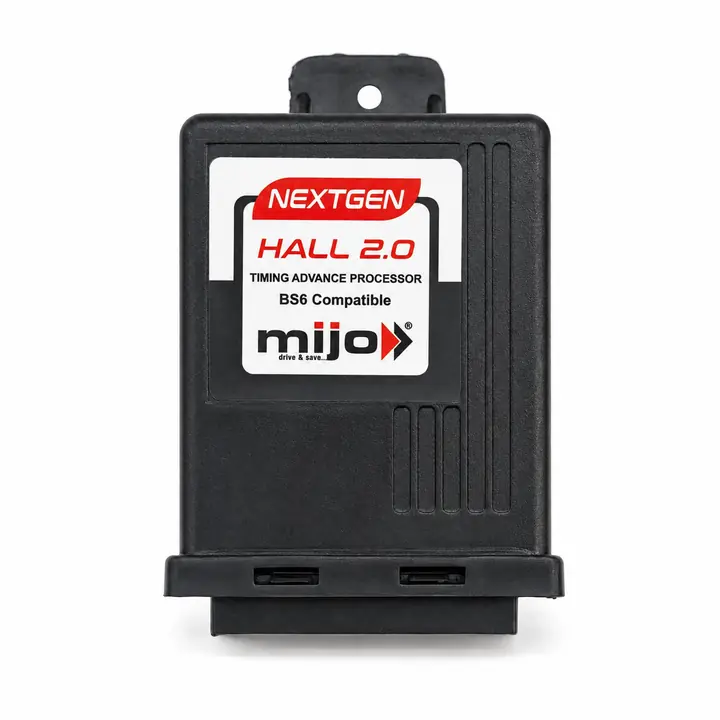
Latest MIJO technology
01 · Timing advance processor
Hall 2.0
Internet-validated crank-sensor timing advance processor
Hall 2.0 is MIJO's latest crank-sensor-based timing advance processor and the lead model in the range. It is developed for vehicle-specific optimization on CNG, where correctly managed ignition advance helps deliver sharper pickup, stronger acceleration and more responsive driveability.
Its Hall-signal architecture can process one Hall-effect crankshaft-position (CKP) signal together with as many as two Hall-effect camshaft or phase signals. This gives Hall 2.0 capacity for three Hall timing signals in supported 3-, 4-, 5-, 6- and 8-cylinder vehicle applications.
During setup, the installer connects the supplied software to the internet and validates the Hall 2.0 unit online. After validation, the software provides the compatible-vehicle list, the wiring diagram for the selected vehicle and its dedicated tuning file, giving the installer one guided route from vehicle identification to final calibration.
The vehicle-specific tuning files are the core of Hall 2.0's performance. They let the processor apply an optimized timing strategy for the selected application instead of relying on a generic setting, making Hall 2.0 MIJO's most advanced timing-advance platform for supported vehicles.
Hall 2.0 signal architecture
One Hall-effect CKP input plus up to two Hall-effect cam / phase inputsProcesses up to three Hall timing signals in supported 3-, 4-, 5-, 6- and 8-cylinder applications.
Key characteristics
- Latest MIJO platformThe newest and most advanced timing advancer in the MIJO range.
- Online validationThe product is validated through the internet-connected setup software.
- Vehicle databaseCompatible vehicles and vehicle-specific wiring diagrams are available after validation.
- Optimized tuningA dedicated tuning file is selected for the supported vehicle application.
Technical selection data
- Model
- Hall 2.0
- Timing reference
- Hall-effect crank and cam / phase signals
- Crank sensor input
- 1 Hall-effect CKP sensor
- Cam / phase sensor inputs
- Up to 2 Hall-effect sensors
- Hall signal capacity
- Up to 3 timing signals in total
- Supported engine layouts
- 3, 4, 5, 6 and 8 cylinders, application dependent
- Supply voltage
- 10–14 V DC
- Advance settings
- 6°, 9°, 12° or 15°, selected for the application
- Engine-speed output
- 0–12 V RPM signal
- Deceleration control
- Advance can be disabled through the TPS signal
- Setup platform
- Internet-connected MIJO software
- Product validation
- Online validation during setup
- Installer resources
- Vehicle list, wiring diagrams and tuning files
- Calibration
- Vehicle-specific tuning file
- Performance objective
- Optimized pickup and acceleration on CNG
- Installation
- Professional vehicle-specific setup
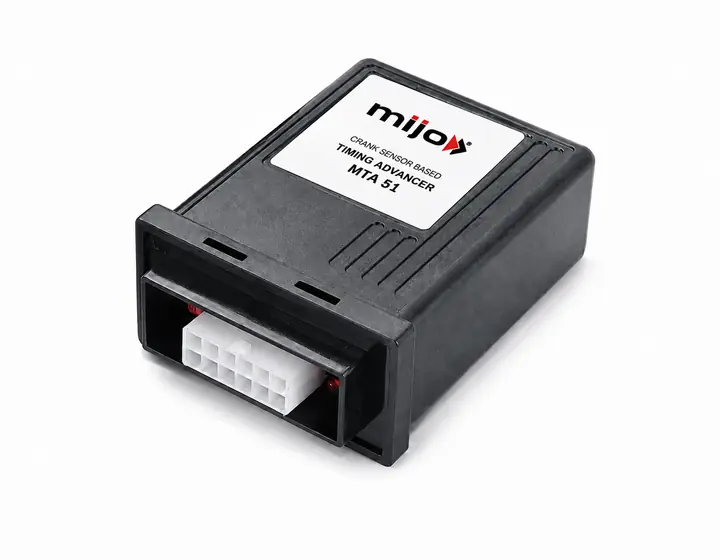
02 · Timing advance processor
MTA 51 crank-sensor range
Spider · Cobra · Shark · Panda
This family works from the crank-position signal, with the correct processor selected according to whether the vehicle uses inductive or Hall-effect crank and phase sensors. Each model has a different signal-handling role.
MIJO supplies Spider, Cobra and Shark in the configuration matched to a supported vehicle application. Panda is the programmable multi-application option; MIJO loads the correct vehicle program before professional installation.
Spider
One Hall crank-position signal, with an optional Hall phase input where requiredSupplied pre-programmed by MIJO for supported Maruti and Hyundai applications.
Cobra
One inductive crank-position signalSupplied in the matched configuration for the supported vehicle application.
Shark
Inductive crank + up to two Hall phase sensors, or Hall crank + one Hall phase sensorUsed for supported vehicle-specific applications that need combined crank/phase handling.
Panda
Hall crank-position + one Hall phase sensorProgrammable multi-application unit; MIJO loads the correct vehicle program before installation.
Download wiring diagramKey characteristics
- Signal referenceCrank-position signal.
- Model familiesSpider, Cobra, Shark and Panda.
- Sensor typesInductive and Hall-effect arrangements.
- SelectionVehicle, crank/phase signals and application must be confirmed.
Technical selection data
- Timing reference
- Crank-position sensor
- Spider
- Hall crank + optional Hall phase input
- Cobra
- Single inductive crank input
- Shark
- Combined crank and phase-sensor arrangements
- Panda
- Programmable Hall crank + Hall phase applications
- Setup
- Application-matched by MIJO
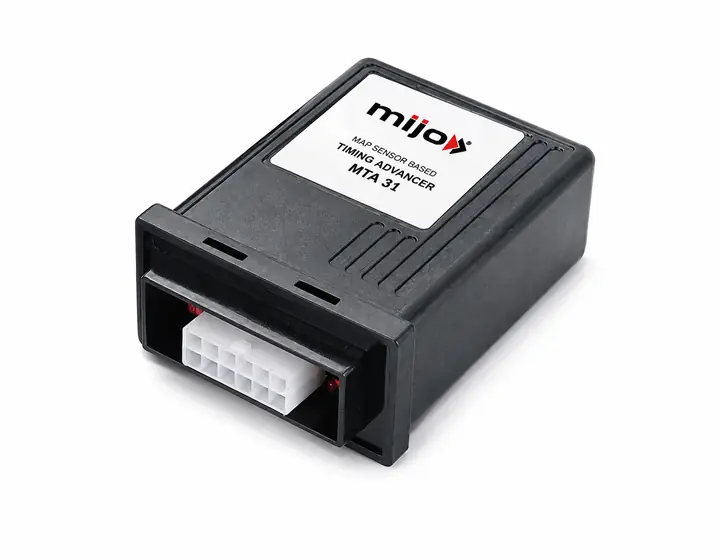
03 · Timing advance processor
MTA 31
MAP-sensor-based timing advance processor
MTA 31 is MIJO's MAP-sensor-based timing advance processor for supported older and conventional-engine gas-conversion applications. It reads engine load through the MAP signal and applies the timing correction selected for the vehicle.
The unit is supplied only after the engine, MAP-signal route and installation arrangement have been confirmed. Professional matching remains essential because MTA 31 is not a universal fitment for every older engine.
Key characteristics
- Signal referenceMAP-sensor signal.
- ApplicationSupported older and conventional-engine conversions.
- ConfigurationStandalone processor control unit.
- SelectionVehicle, engine signal and wiring must be confirmed.
Technical selection data
- Model
- MTA 31
- Timing reference
- MAP sensor
- Application route
- Older / conventional engine, where supported
- Connection
- Application-specific vehicle connection
- Setup
- Matched during professional installation
Range comparison
Compare the signal routes and model roles.
Selection is based on the vehicle's sensor architecture and application, not on a marketing tier.
| Model | Signal architecture | MIJO application route |
|---|---|---|
| Hall 2.0 | One Hall CKP input + up to two Hall cam / phase inputs | Up to three Hall timing signals with online-validated, vehicle-specific tuning |
| Spider | One Hall crank-position signal, with an optional Hall phase input where required | Pre-programmed for supported Maruti and Hyundai applications |
| Cobra | One inductive crank-position signal | Matched to supported vehicle-specific applications |
| Shark | Inductive crank + up to two Hall phase sensors, or Hall crank + one Hall phase sensor | Matched to supported applications requiring combined crank/phase handling |
| Panda | Hall crank-position + one Hall phase sensor | Programmable multi-application unit configured by MIJO for the vehicle |
| MTA 31 | MAP-sensor reference | Supported older and conventional-engine applications |
Selection sequence
Four checks before choosing and tuning a processor.
The product name alone is not enough. MIJO confirms the signal route, exact vehicle application and setup path before supply.
- 01Confirm the vehicle, model year and engine
- 02Identify the MAP or crank-sensor signal route
- 03Match the sensor and connector arrangement
- 04Validate Hall 2.0 online or complete the model-specific setup
Common questions
Timing advance processor selection.
What does a timing advance processor do?
It applies the timing correction matched to the engine signal during gas operation. In a supported and correctly tuned CNG application, this helps improve pickup, acceleration and throttle response.
How is Hall 2.0 configured?
The installer connects the supplied software to the internet and validates the Hall 2.0 unit. The software then provides the compatible-vehicle list, the selected vehicle's wiring diagram and its dedicated tuning file for professional setup.
Is one processor suitable for every vehicle?
No. The processor family, variant, wiring and connector must match the exact vehicle and engine-management system.
How do I choose between Hall 2.0, the other crank-sensor models and MTA 31?
Hall 2.0 is MIJO's latest online-validated crank-sensor platform for supported vehicles. Spider, Cobra, Shark and Panda cover other crank and phase-sensor arrangements. MTA 31 follows a supported MAP-sensor route for older or conventional-engine applications. MIJO confirms the correct option from the vehicle and its engine signals.
Next step
Need the correct timing advance processor?
Share the vehicle make, model, year, engine and available sensor or connector details with MIJO.